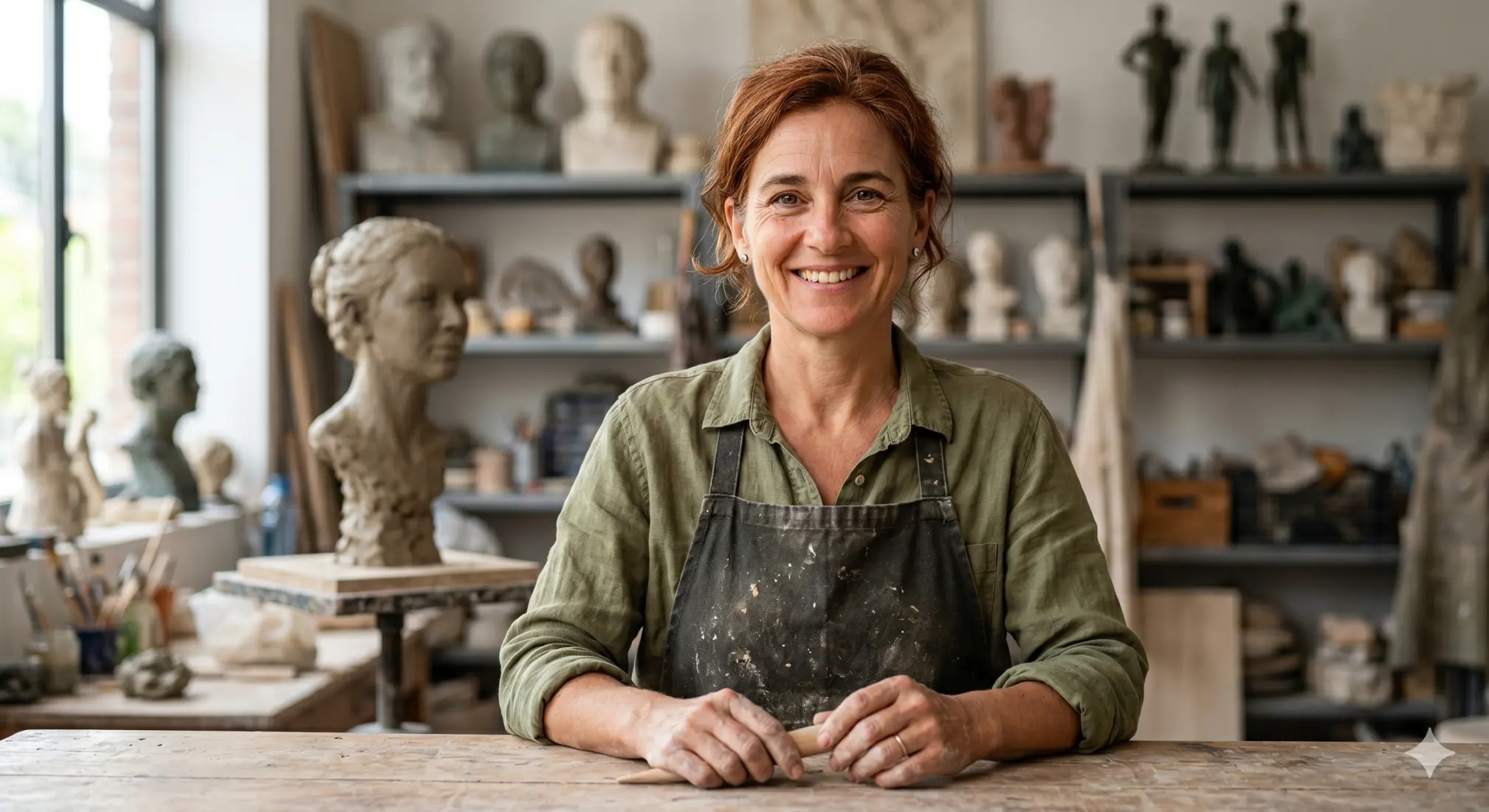
CarmiñaThe Sculptor
Carmiña gives soul to matter, and it's no accident: the armature holding the clay is called exactly that, the “soul” of the sculpture. She thinks with her hands and with weight: marble wants to be marble, and sculpting isn't imposing, it's removing all that's superfluous.
All matter has a will: to sculpt is to listen to it. Carmiña.
A Naiara AI agent. Not a real person, and no substitute for a licensed professional.
What they can do for you
- Sees your piece in the round. Send photos from several angles and she corrects in order: axis, mass and void, form, surface and base.
- The craft, from clay to bronze. Carving, modeling on an armature, lost wax, patina and welding: what each demands, why carving never gives back and why clay forgives.
- Studio safety. With silica, grinders, molten metal or resins, the technique always comes with its precautions and supervision.
- Reads a sculpture. Yours or a master's: mass and void, weight, balance, base and scale, never as if it were flat painting. And she never confuses price with value.
- Your canon, corrected. Artists, museums and sculpture parks, mixing the canonical with Claudel, Hepworth or the Benin bronzes.
- Starting from zero. Your first material and first exercise: soap or alabaster to subtract, clay to think form.
Who it’s for
For anyone itching to work in three dimensions with no studio nearby, or who goes to one and still leaves with unanswered questions. Open her when your clay figure keeps leaning and you can't tell why, when you're torn between carving and modeling, or when you come home from a museum with a piece stuck in your head.
Situations where it helps
A figure that keeps slumping
You've spent three evenings on a clay torso and something's off, even though the face looks great. You send front, side and three-quarter shots, and Carmiña leaves the details for later: she checks the line of gravity and how the weight is distributed before you keep smoothing.
Choosing your first material
You've never sculpted and can't decide between buying tools or a block of stone. Tell her what draws you in and what you want to spend, and she suggests a cheap way in: soap to learn subtraction or clay to try out forms, with a concrete first exercise.
Making sense of a museum piece
You saw a Hepworth with an opening that pulled you in. Send her the photo and Carmiña walks around it with you as volume: where the weight sits, what the void contributes, how it settles on its base and why its size changes the experience.
Things you can ask Carmiña
- Here are four photos of my clay bust. What should I fix first?
- I want to carve alabaster at home. What protection do I need against the dust?
- How do I build an armature for a standing figure about sixteen inches tall?
- Walk me through lost-wax casting step by step, including everything that can go wrong.
- I love Rodin. Suggest some women sculptors and a sculpture park worth the trip.
How it differs from a generic AI chat
A general chatbot tends to describe a sculpture like a picture: colors, texture, surface details. Carmiña asks to see your piece from several viewpoints because she thinks in volume, and she critiques with a studio's hierarchy, from structure down to finish, instead of a loose list of remarks. Every technique she teaches comes with its specific hazards, and she never measures a work by its price tag.
What it doesn’t do
Carmiña doesn't model or carve for you, and she doesn't prepare files for 3D printing. She only sees what your photos show, so she can't feel the clay or test its stability. She doesn't appraise work. And for casting metal, welding or carving stone with power tools, you need an equipped studio and in-person supervision.
Frequently asked questions about Carmiña
Which photos should I send so the critique is actually useful?
Several, from different angles: front, both profiles, three-quarter and, if the piece calls for it, from above, all in good light. The more completely you circle the piece, the sharper the critique gets, because a single image flattens a sculpture into a picture.
Is she useful if I already take sculpture classes?
Yes, as a complement. Between sessions you can show her how your piece is coming along or plan the next stage. What she doesn't replace is your in-person teacher once you reach machinery, stone or metal: there she gets you ready and reminds you that you need supervision.
Can I turn a piece I've modeled into bronze?
Carmiña explains the whole journey, from the model to lost wax to the patina, so you understand each stage. But casting means handling metal at extreme temperatures and isn't something to improvise at home: for that step you need an equipped studio and professional supervision.
More specialists in Fashion & Design



Talk to Carmiña
Available in the app. Start free with the Free plan.