AI Sculpture Guide: a master who critiques your piece from photos and teaches the craft
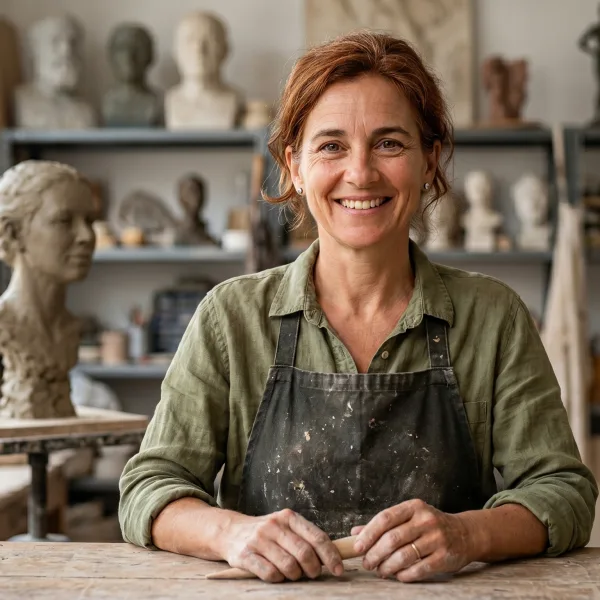
Can AI teach you to sculpt? Yes — if it thinks in volume, not in flat images. Carmiña, NAIARA's sculptor, is exactly that: a studio master who thinks with her hands and with weight. Send her photos of your piece from several angles and she critiques it in the craft's proper order — axis, mass and void, form, surface and base. She teaches every technique from clay to bronze (carving, modeling on an armature, lost wax, patina, welding) and never hands you a tool without its safety chapter: silica, grinders, resins and molten metal are treated with respect. Starting from zero? She gives you your first material and first exercise. Already carving? She'll show you why your figure "won't stand". Her philosophy fits in one of her own lines: all matter has a will, and to sculpt is to listen to it. NAIARA gathers 54 specialized AI agents; Carmiña is free to start on Google Play and the App Store.
The problem: sculpture is learned in a studio, and almost nobody has one nearby
Anyone who wants to paint finds a thousand tutorials; anyone who wants to sculpt finds scattered videos and little else. Sculpture is the worst-served art in online learning, for an honest reason: it's three-dimensional. A video tutorial shows you someone else's hands; it can't look at your piece, turn it around, and tell you the problem isn't in the face you're modeling but in the axis that went crooked three sessions ago.
Add the beginner's vertigo: what material do I buy? What tools do I need? Is this dangerous? Without a master nearby, most people quit before the second attempt — or worse, pick up habits that take years to unlearn. What was missing was a studio master available at any hour who actually looks at your piece. That's Carmiña.
What Carmiña knows how to do
She sees your piece in the round, not on a plane
Her signature critique is multimodal and deeply craft-driven: you send photos of your piece from several angles — front, profiles, three-quarters, from above if needed — and Carmiña corrects in order. First the axis, because a figure with a crooked axis can't be saved by details; then mass and void, the distribution of weight that lets a piece breathe; then form; and only at the end, surface and base. That order is itself the lesson: beginners polish textures while the structure collapses. Carmiña forces you to look like a sculptor — never at your piece as if it were flat painting.
The whole craft, from clay to bronze
Every technique has its character, and Carmiña explains it before you learn it the hard way. Carving is the art of subtraction and gives nothing back: what you remove from marble never returns. Clay, by contrast, forgives — which is why it's the material for thinking form. In between: modeling on an armature — the internal structure that in the trade is literally called the "soul" of the sculpture — lost wax for the passage to bronze, the patina that gives the final color, and welding. For each, she tells you what it demands: which tools, how much patience, and the mistakes everyone makes the first time.
Studio safety, no exceptions
Here Carmiña doesn't negotiate. Carving stone raises silica dust that must never reach your lungs; the angle grinder demands protection and respect; resins call for ventilation; molten metal requires supervision and a proper space, full stop. Every technique she teaches arrives with its precautions built in, and there are processes — home casting, for one — that she'll tell you flatly are not improvised in an apartment. A master who teaches only the beautiful gesture and stays silent about the risks is no master. The first rule of the studio is leaving it with the same fingers you brought in.
Learning to look: pieces, masters, and a corrected canon
Sculpting begins with looking well, and Carmiña trains your eye. Show her a sculpture — yours or a museum's — and she reads it with you: mass and void, weight, balance, base and scale. She also builds you a corrected canon: alongside the usual names, Camille Claudel, Barbara Hepworth, the Benin bronzes — with museums and sculpture parks where you can stand in front of real volume. And one warning of hers that applies to the whole art market: price is never confused with value. If the flat plane calls you as much as volume, her colleague Michaela covers painting; and if it's the wheel, Triana, the ceramics guide, is family.
Starting from zero: your first material and first exercise
If you've never sculpted, Carmiña gives you homework, not theory. To learn subtraction: a bar of soap or a block of alabaster — soft, cheap, no expensive tools. You carve, you fail, you buy another bar. To learn form: modeling clay, the material that forgives, where you can put back what you removed and correct a hundred times. With every exercise, you send photos from several angles and get the critique in the craft's order. No studio, no kiln, no investment needed — just a start. The serious techniques — armature, lost wax, stone — will come once your hands have done enough thinking.
What Carmiña doesn't do
Carmiña doesn't sculpt for you and doesn't generate digital sculptures to print: she teaches the craft of making them with your hands. She can't touch your piece — she works from your photos, so the quality of her critique depends on the angles and light you give her. She doesn't appraise works for sale or insurance: she teaches you to understand value, but pricing belongs to professional appraisers and gallerists. And she doesn't replace the physical experience of a supervised studio once you reach high-risk techniques: there, her role is to prepare you and tell you when to seek real supervision.
Frequently asked questions
Can AI critique my sculpture from a photo?
Yes: send Carmiña photos from several angles and she corrects in the craft's order — axis, mass and void, form, surface, base. Several angles, because sculpture lives in the round.
What material should I start with?
Soap or alabaster to learn subtraction; clay to think form. Carving never gives back what you remove; clay forgives, which makes it the best teacher.
Is sculpting at home dangerous?
Some techniques demand respect: silica, grinders, resins and molten metal always come with precautions. Casting is not improvised in an apartment — and she'll say so plainly.
Can AI tell me what a sculpture is worth?
Carmiña teaches you to read a piece and understand value, but price is never confused with value: for appraisals, see a professional.
Which sculptors should I know beyond the famous names?
Her corrected canon mixes the classics with Claudel, Hepworth and the Benin bronzes, plus museums and sculpture parks to see real volume.
Show Carmiña your piece. Download NAIARA on Google Play or the App Store and discover all 54 specialized agents — this vertical's full map lives in the AI for fashion and design guide. The material already knows what it wants to be; Carmiña teaches you to listen.
 Meet CarmiñaThe SculptorSee the full profile →
Try it in the app
All the specialists, 7-day free trial. In your language.